

Ship Auth directly from your terminal (Sponsored)

Run npx workos@latest to launch an AI agent that reads your project, detects your framework, and writes the auth integration directly into your codebase. No account required upfront. WorkOS automatically creates your environment and keys, then lets your claim the project when you're ready.
Once installed, manage users, orgs, and environments directly from the terminal.
This is Part 2 of our series with Shah Rahman, Global Head of Autonomous ML Iteration & Optimization for Ads at Meta, where he architects AI-native infrastructure and multi-agent systems at hyperscale. Connect with him on LinkedIn.
Part 1, published two weeks ago, was written for the individual engineer. Shah covered:
The shift from engineer to orchestrator
The four core practices: context engineering, spec-driven development, critical verification, and problem decomposition
The Agentic Development Life Cycle (ADLC)
The security guardrails that are no longer optional
Part 1 was about the person. Part 2 is about the organization. Here we cover:
Pod-based structures and the Agent Champion model
The leadership crisis from first principles: ownership, empathy, and deciding what to build
A phased transformation playbook, plus the metrics that prove it worked
Individual gains do not become organizational gains on their own. This is the playbook for making that leap. Let’s dive in.
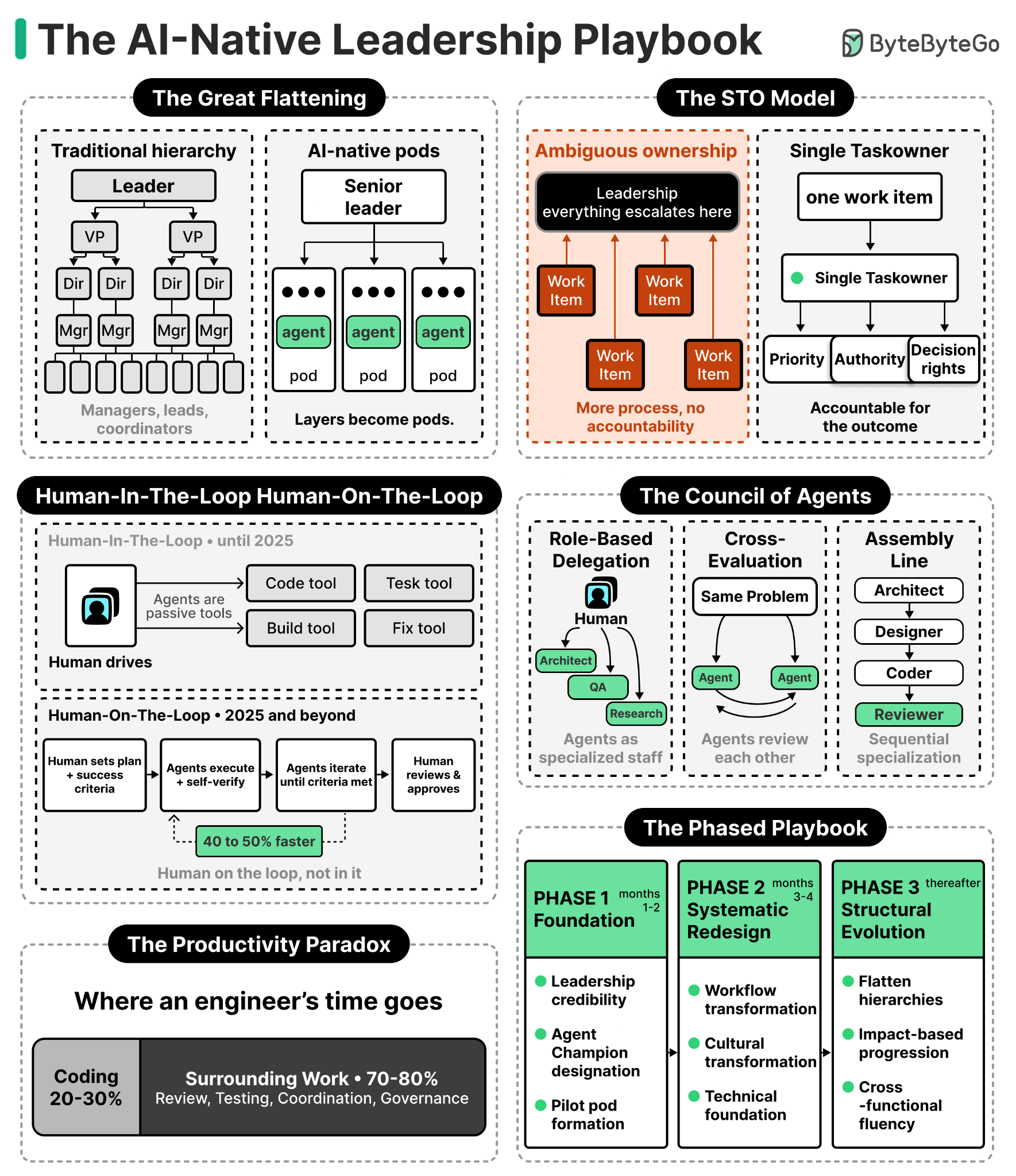
The Great Restructuring
AI-native leadership is the most significant organizational transformation since the industry moved to agile more than a decade ago. Several companies watched AI-generated code climb from zero to 50 or 60% of their output inside a single year. Select teams have posted 2 to 10x productivity gains.
But we keep learning the hard way: individual tool usage produces individual gains, while systemic improvement takes deliberate leadership and a redesign of how work flows.
The evidence is hard to argue with. Around 70% of transformation success comes from operational and cultural change rather than from deploying technology. And most organizations get this wrong. They distribute tools, measure adoption rates, and then wonder why velocity refuses to move.
But some organizations are getting real results. At Shopify, CEO Tobi Lutke told employees that AI usage is now a baseline expectation, and that teams have to show why a task cannot be done by AI before they ask for more headcount. At Klarna, AI-driven restructuring reduced the workforce by more than a thousand people. These organizations treat AI as a fundamental operating model change, not a tooling upgrade. Almost everyone else is now racing to catch up.
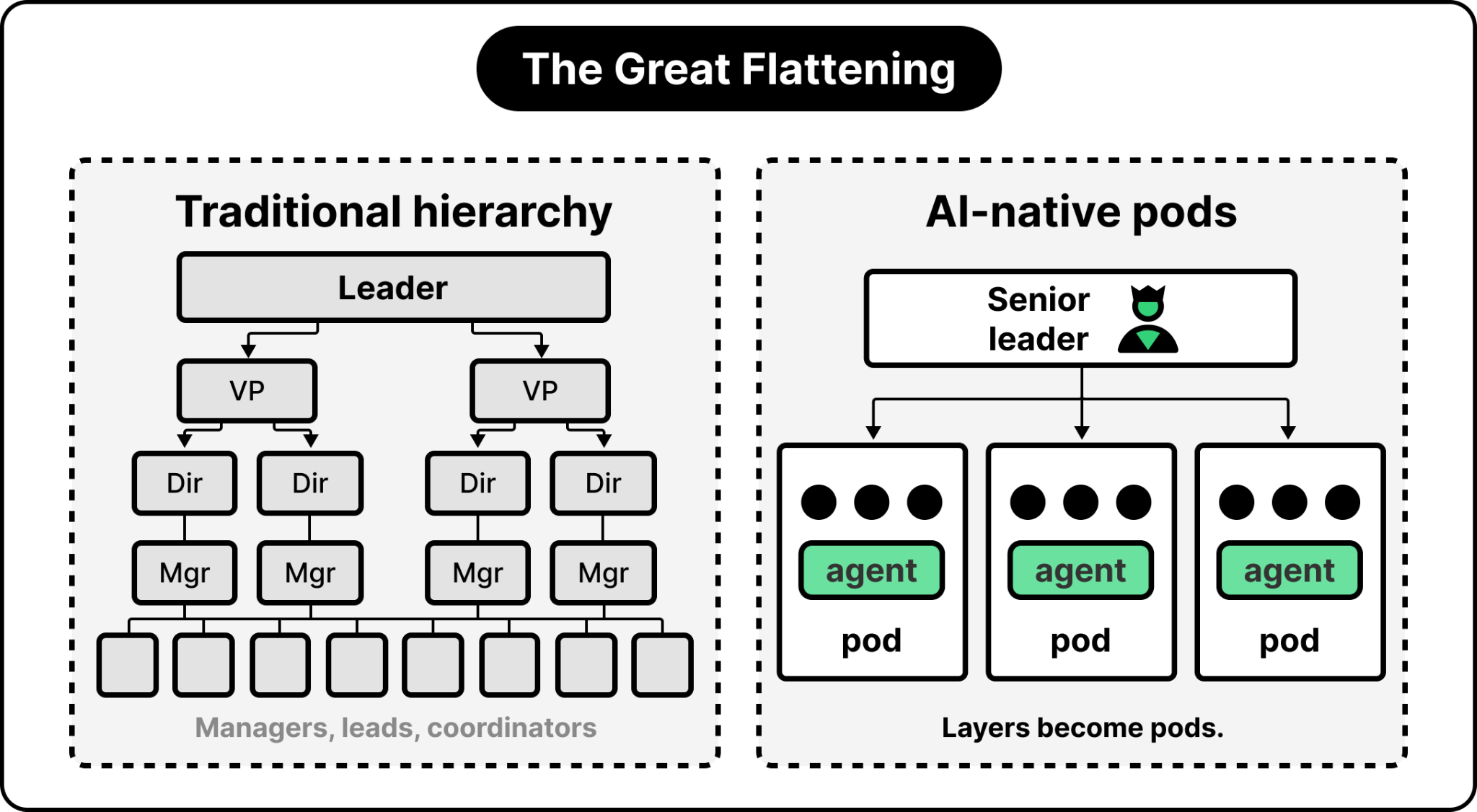
Podified Organizational Structure
This is the atomic unit of AI-native engineering is the small, cross-functional team: 3 to 5 people operating autonomously with AI agents and tools. The hierarchies established during the dot-com era, all those layers of managers, leads, and coordinators, are being dismantled.
When a 10x engineer armed with AI tools can do what used to take a much larger group, the organizational consequences are significant. Some pods now report directly to senior leaders based on strategic importance. Team impact gets redefined around outcomes rather than headcount.
The results from one established team’s pod pilot were striking: 3 projects running on self-sufficient agentic loops, more than 90% engineer adoption across the org in under two months, and features built in hours rather than days using agent-assisted development loops.
Roles become fluid in this setup. Engineers may design, designers may code, and product managers may prototype directly. This is not role confusion, it is capability amplification. AI removes the traditional skill bottlenecks, so teams operate with more judgment and less procedural overhead.
Build Durable Agents With Open Source Frameworks (Sponsored)

Most AI agents work in demos — but fail in production. Learn how to build durable, enterprise-ready AI agents with open-source frameworks using Orkes Agentspan and Conductor. This whitepaper explores how to orchestrate long-running, fault-tolerant agent workflows with built-in governance, observability, retries, and human approvals. See how Agentspan compares to LangGraph, CrewAI, and AutoGen for real-world enterprise AI systems. If you’re building AI workflows that need reliability, scale, and control, this guide shows the architecture patterns that make production-grade agents possible.
Implementation Steps
While your implementation will be your org-specific, here’s a usable template:
Start with 1 or 2 pilot pods aimed at high-priority challenging issues that block entire teams.
Strip out non-essential review layers and reduce pre-approval friction.
Formalize autonomy so pods can decide for themselves between failing fast and pushing forward.
Only scale after the pilot metrics validate the results. Resist arbitrary rollout timelines.
The Agent Champion Model
Every pillar should name 1 or 2 full-time Agent Champions, responsible for reshaping workflows, preparing codebases, and restructuring operating models. This is not a side-of-desk assignment. It calls for dedicated, high-agency technical leaders who spend 50 to 100% of their time on the transformation itself.
The Champion model reaches well beyond traditional engineering:
Product mgmt. champions redesign product reviews, experiment workflows, and cross-functional handoffs for autonomous execution.
Design champions build agent-first prototyping frameworks while protecting craft standards.
Analytics champions let agents run analyses at a scale that was never possible before, on top of an AI-native data infrastructure.
One important note: engineers working with Agent Champions write 70%+ of their code with AI assistance, shifting from human-in-the-loop to human-on-the-loop. The implication is that when those engineers make manual edits, it signals missing AI context rather than business as usual.
Four things matter the most for anyone stepping into the Champion role:
Lead with personal AI adoption first: use the tools daily and share what happens, the wins and the failures alike.
Commit to the vision of AI as foundational to strategy, not an optional enhancement.
Remove barriers through structured, individualized engagement with each team.
Recognize impact based on productivity gains and business outcomes, never on tool usage metrics.
Leadership Competency Evolution
Senior leaders are spinning up “AI-native managers” and “AI-native leaders” groups that go deep on the operating context: processes, tools, reporting, and metrics. This is a competency evolution that educational institutions simply cannot keep pace with yet and hence, the need for such learning and development groups at most organizations.
The leadership competency shifts from delegation to orchestration. You are managing multiple parallel AI workflows, not assigning tasks to humans. Technical depth becomes non-negotiable. Hands-on managers have to evaluate agent-generated code and stand up verification layers. And context engineering becomes a core leadership skill, because the precision of the guidance you give AI systems is the precision your teams inherit.
AI-Native Leadership Crisis From the First Principles
Before we go any deeper into the playbook, it is worth stepping back to the core crisis underneath it all.
The Bottleneck Was Never Building
This is the insight most organizations miss. The dominant narrative celebrates AI’s speed: solo founders shipping with agents, dramatic productivity claims, demos everywhere. But the parts of software development that were always hard, remain hard:
Deciding what to build among competing options
Identifying the features users actually need
Prioritizing the capabilities customers will pay for
Knowing when to kill a project that lacks clear feedback
Have you heard that building great software is an act of empathy? AI cannot replicate a human understanding of user friction or the emotional stakes inside a product decision. Multiple Y Combinator partners have made the same argument: product taste, design sensibility, and customer empathy become the differentiating human skills once execution is commoditized.
The danger shows up when cheap coding invites excessive feature creation. Users do not get 10x more cognitive bandwidth just because you can ship 10x more features. Teams spiral into uncontrolled development and manufacture false progress.
The shift that matters is asking whether something should be built at all rather than asking if it can be built faster.
The Ownership Problem
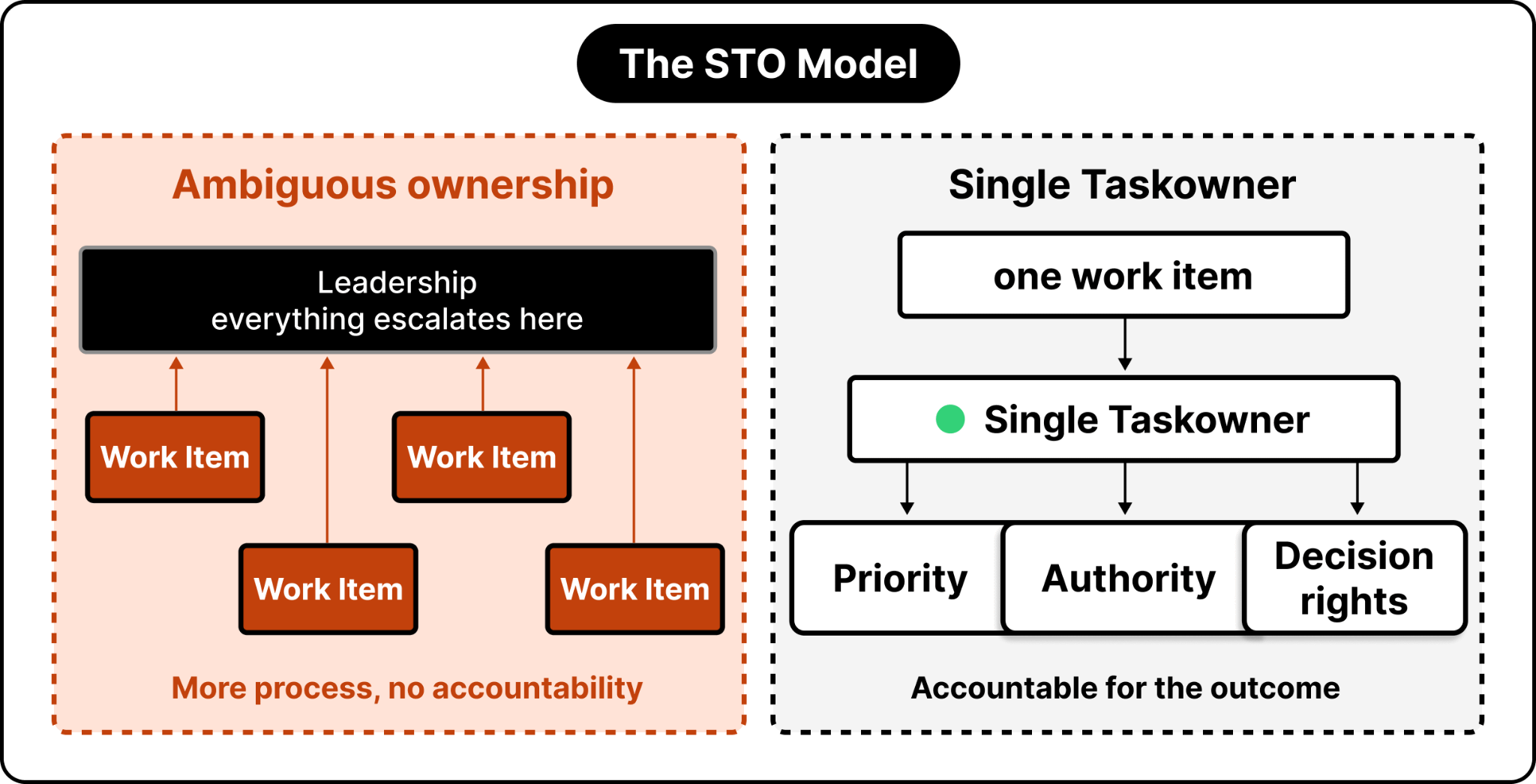
Anecdotally, most dysfunction in AI-native organizations comes from unclear ownership, not bad process. Even the most empowered teams get fuzzy when responsibility is ambiguous. Work gets picked up or dropped based on whatever is most urgent that day. Leadership becomes the escalation path for every decision, which hollows out middle management and triggers the great flattening.
Piling on more processes to fix a process failure only deepens the hole. The principle is that if something is important enough, give it to a single owner and make them accountable for the outcome.
We put this into practice with a “STO for Everything” model, where STO stands for Single Task Owner. Each one carries clear priority, authority, and decision rights. This single change turbocharged our transformation by eliminating the coordination tax that ambiguous responsibility almost always creates.
Why AI Amplifies Ownership Problems
Because, AI dramatically expands the surface area of parallel work. More projects in flight means more coordination overhead, which triggers an instinct to add process. When ownership stays undefined, those ad hoc processes become bureaucratic substitutes for accountability, and you end up in a vicious cycle.
You can automate coordination with agents (dependency tracking, scheduling, status summaries), but that only buys temporary relief. It masks the underlying challenges that nobody owns. The moment key people leave, those challenges surface and the systems collapse.
If you want to fix it, you must own the outcome, not the process. Map the STO model onto the human-on-the-loop paradigm: humans set direction, verify outcomes, and make irreducible judgments, while AI handles the mechanics of execution.
We Keep Making the Wrong Thing Better
The most common failure I have watched play out is that teams spend months perfecting products that have no product-market fit. They polish the UI, add settings, refine the copy, all of it generating false progress without changing the trajectory. AI makes this temptation worse by dropping build costs to hours, proliferation of code now drives unvetted product frenzy
The discipline is to test the hypothesis before committing to development. Ask “What is the scrappiest way to learn whether this matters?” before you build anything. The rapid prototyping ecosystem (Vercel’s v0, Replit Agent, Lovable, Bolt.new) makes that nearly costless.
Then design to 50-60%. Ship the minimal functionality that enables the core user journeys. Watch where users hesitate, misunderstand, or abandon. That tells you the real product challenges instead of the imagined ones. Over 70% of features never reach a real user. In the age of AI, there is no excuse for building fully polished features that nobody wants.
The temptation is real, but giving into it may decide the winner vs. loser product.
Human-Agent Collaboration: The First Step To Tackle the Crisis
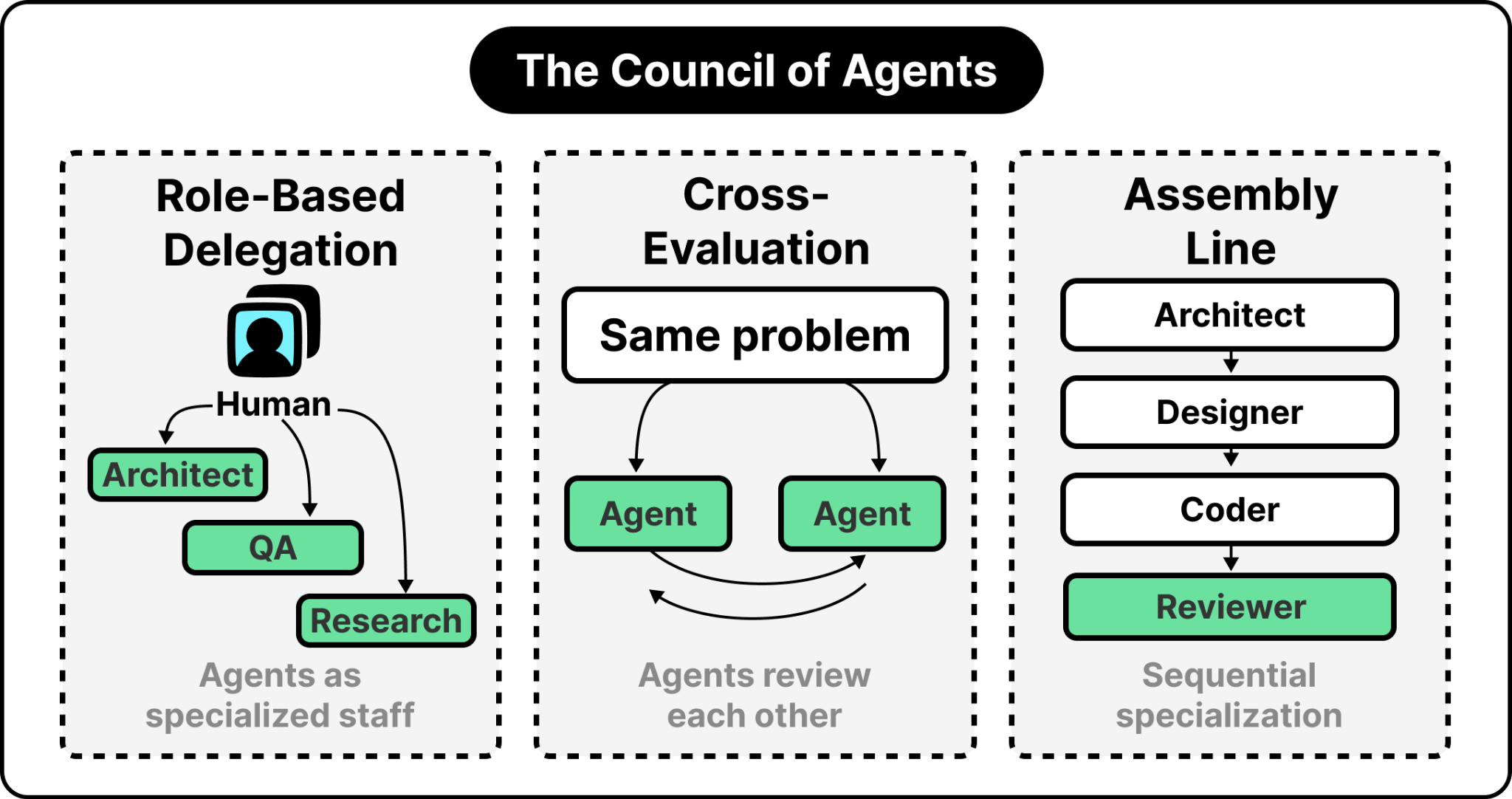
The Council of Agents
Power users have moved past simple human-AI pairing and into orchestrating multiple specialized AI systems that effectively set up a council of agents. There are few different modalities these councils can take.
Role-based delegation treats agents as specialized staff, each with a distinct persona. Cross-evaluation systems deploy multiple agents to independently analyze a problem and review each other’s work. Assembly line workflows chain sequential specialization: architect, then designer, then coder, then reviewer.
Agent-First Development
The emerging pattern aims at autonomous, agent-driven development, where agents code, build, test, and fix issues while humans provide oversight. The key distinction is that agents drive the actual tasks, and humans step in when agents hit an obstacle, not the other way around.
A few touchpoints make this collaboration work. Every AI module ships with context files that carry a clear architecture context. Work breaks into small, manageable, verifiable chunks. Quality assurance never assumes the AI got it right. And multi-agent coordination manages the interactions between specialized agents.
Teams running AI-first approach often report 2 to 10x acceleration across a wide range of tasks, conditional on getting the foundations right first.
From Human-in-the-Loop to Human-on-the-Loop
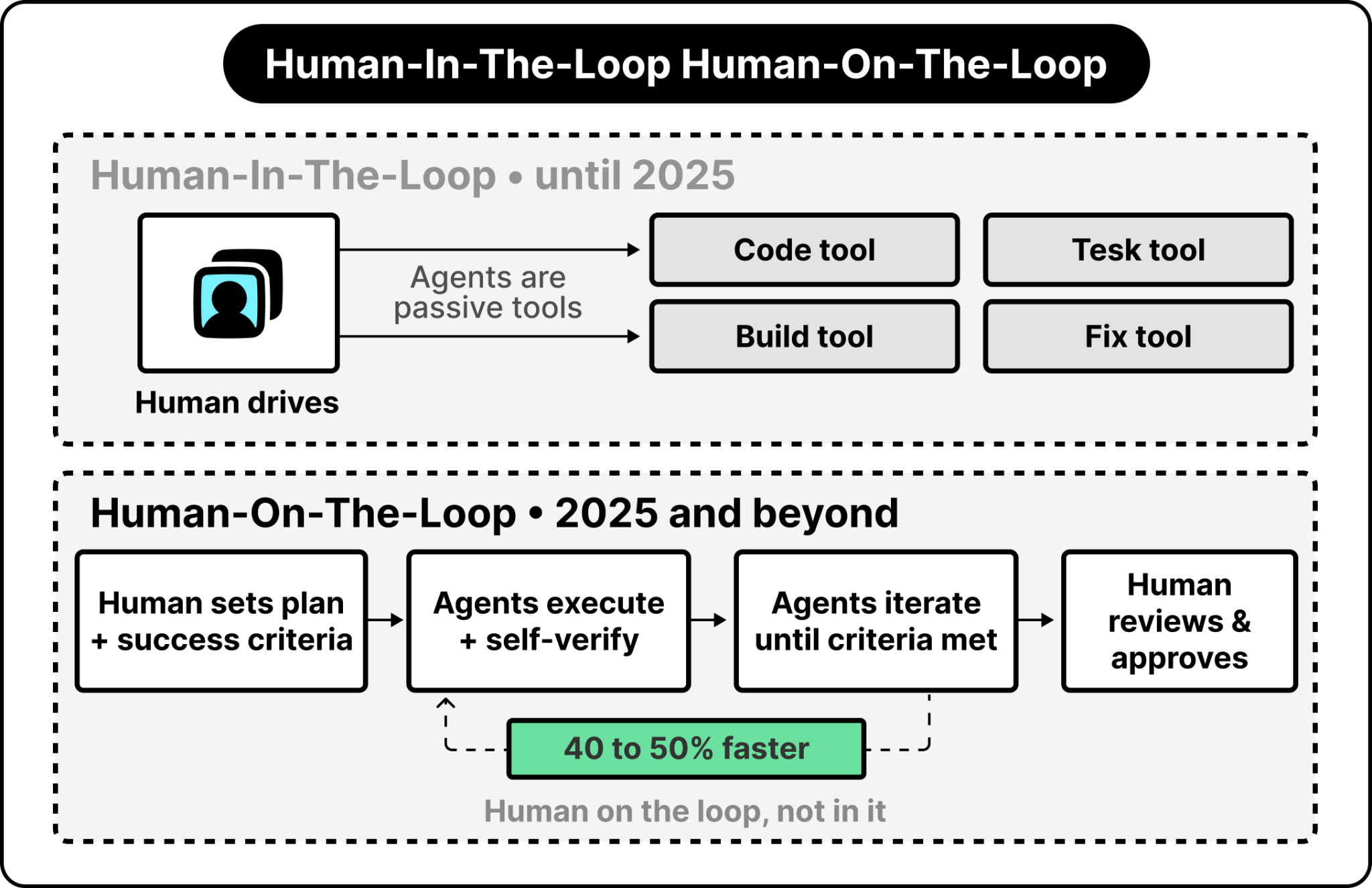
Until 2025, humans had to drive agents hands-on. This year, AI agents have advanced enough so that humans no longer need to sit in the driver’s seat. AI agents self-drive while humans provide oversight, governance, and stay in the loop.
One large team made the shift cleanly. Humans set the plans and success criteria, AI executes the implementation and self-verifies, AI iterates on its own until the criteria are met, and humans review and approve the final output. This semi-autonomous approach delivered a 40 to 50% speedup over their previous development loop.
The other results have been just as compelling.
One team’s “Squad of AI Agents” approach drove revenue impact that used to be barely a P25 goal. Another rolled out AI-native workflows targeting 2X-plus productivity, with agents autonomously managing code from authoring through production. A third adopted AI-driven tech debt reduction and gained more than 60% productivity with no quality regression, moving to human-on-the-loop in under 4 months, a transition that usually takes 6 to 12.
Measuring Team Transformation: the Next Important Next Step
Traditional metrics fall apart when AI generates thousands of lines of code in seconds. Measurement has to move from output-based to outcome-based.
The Productivity Paradox
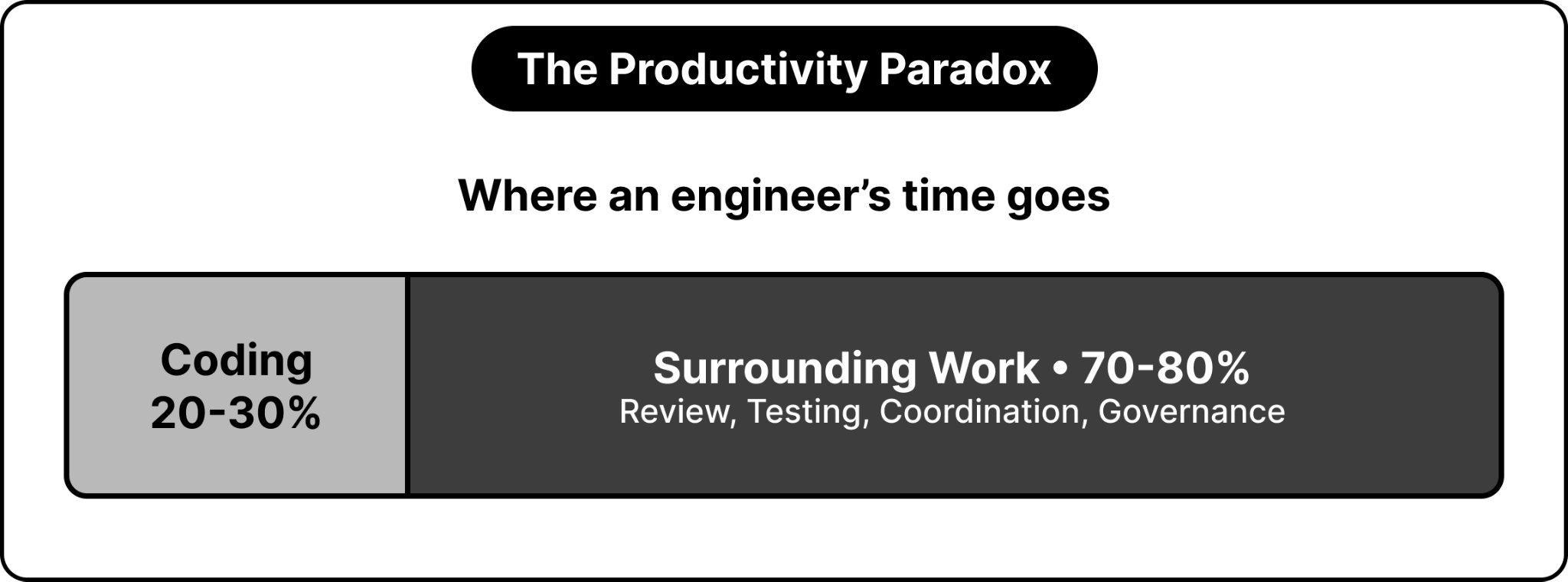
Only 20 to 30% of an engineer’s time is spent coding. Speeding up code generation does not automatically translate into overall productivity. The surrounding work (review, testing, coordination, governance) accounts for the other 70 to 80%, and that is exactly where the bottlenecks form.
Research backs this paradox closely:
McKinsey found developers using AI assistants were 20 to 45% faster on discrete coding tasks, but cautioned that org-level gains were smaller and harder to measure.
Google’s DORA team found AI tools improved individual throughput without automatically improving deployment frequency or change failure rates, absent process changes.
Microsoft Research found a 26% increase in completed pull requests per week, but noted the review burden simply shifted onto other team members.
BCG put it best: real productivity gains require reshaping the work, not just adding tools. The same task done faster matters less than redefining which tasks are worth doing at all.
When one of our teams systematically removed those surrounding bottlenecks, they hit a 1.8 to 2.4x velocity improvement over six months.
Emerging Metrics
Given the productivity paradox, metrics to measure productivity and transformation, must be resilient to the paradox:
AI-First MAU: 75% or more of code AI-generated. Agent-assisted diffs: aim for at least 55% to see meaningful productivity gains. L4-plus AI tool adoption: 80% or more weekly active usage across engineering functions.
For business impact, tie AI usage and productivity gains directly to revenue. Track feature velocity, where the 2 to 10x improvements in prototype-to-production timelines show up. And measure developer experience (satisfaction, flow state, collaboration effectiveness) right alongside the output metrics.
Quality has to be a core metric, not just a guardrail. Watch for “AI slop,” the gradual degradation of a codebase as AI-generated code piles up without adequate review. This is the “nobody’s problem” phenomenon, and it can quietly undermine an entire codebase.
Transformation Anti-Patterns
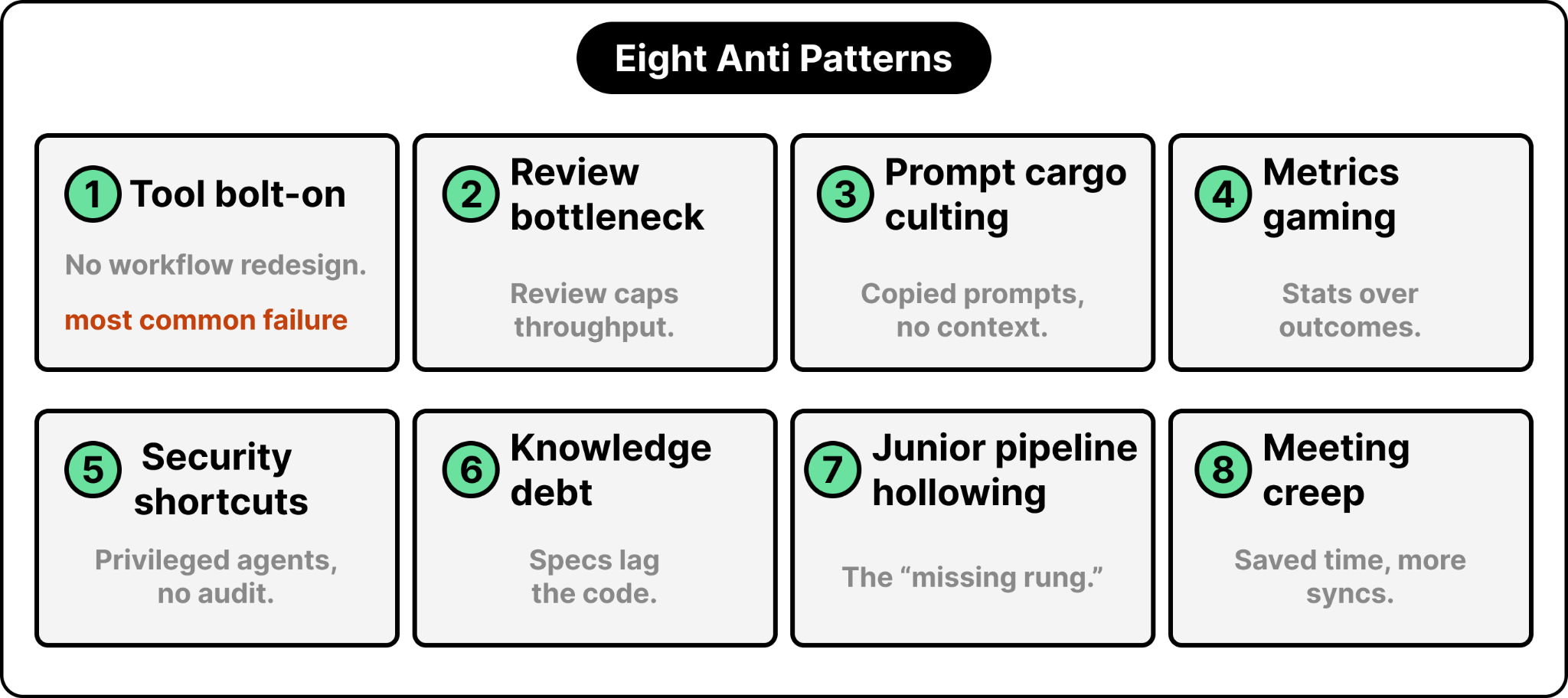
Eight patterns that consistently derail transformation need special attention from every AI-native leader:
Tool bolt-on: AI tools bolted on without redesigning the workflow, producing minimal impact. This is the most common failure mode.
Review bottleneck: Traditional review steps become the throughput limit once AI accelerates generation.
Prompt cargo culting: Teams copy external prompts without context and get poor agent performance. The bottleneck is context engineering skill, not the model.
Metrics gaming: Teams optimize for agent-generated code percentage or adoption stats instead of outcomes.
Security shortcuts: Privileged agents deployed without proper audit controls. Some of the resulting production incidents are real and expensive.
Knowledge debt: Verification and specification fall behind agent-generated work, creating maintainability risk that compounds over time.
Junior pipeline hollowing: Early-career developer experience degrades when human validation gets outsourced to agents. The “missing rung” talent pipeline problem turns into a long-term sustainability risk.
Meeting creep: AI acceleration paradoxically makes room for more frequent syncs with no clear impact. The coordination overhead swallows the time that the faster generation saves.
Success depends on systematically detecting these patterns and rolling out with a real change-management framework like ADKAR (Awareness, Desire, Knowledge, Ability, Reinforcement), backed by structured rollouts and feedback loops. Tool distribution and usage metrics alone will not drive transformation.
The AI-Native Leadership Playbook: A Phased Approach
Now that the AI-native leadership groundwork is in place, here is the phased playbook.
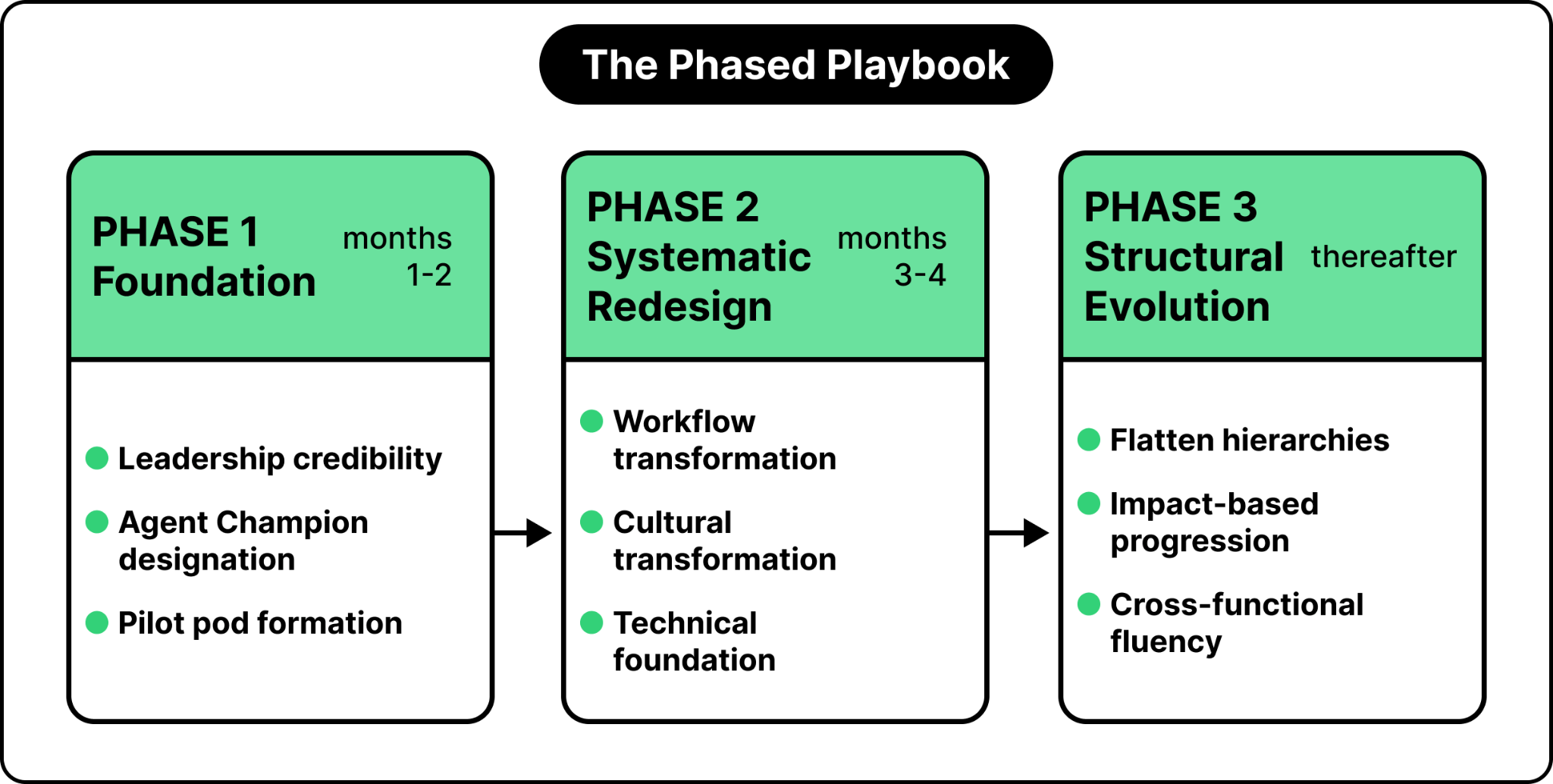
Phase 1: Foundation (the first couple of months)
Leadership credibility: Use AI personally every day with measurable goals. Target 50% or more of your daily tasks within 30 days, then push higher. Get hands-on mastery of the tools so your understanding is authentic. Share both successes and failures in public to model the learning mindset.
Agent Champion designation: Identify high-agency technical leaders who can dedicate 50 to 100% of their time. Pull leaders and individual contributors closer together for faster decisions. Set up cross-functional coordination so the whole end-to-end workflow gets transformed.
Pilot pod formation: Start with a codebase AI readiness assessment. Form 3 to 5-person cross-functional teams with autonomous operation charters. Aim them at real problems, not toy exercises, so the momentum is genuine.
Phase 2: Systematic Redesign (the next couple of months)
Workflow transformation: Audit the high-friction manual workflows that are good candidates for AI. Move from human-in-the-loop to human-on-the-loop. Build AI-readable documentation and specification systems that turn tribal knowledge into shared knowledge.
Cultural transformation: Establish psychological safety: MIT research found 83% of leaders believe psychological safety measurably improves AI initiative success. Formalize “AI failure story” sessions. Shift measurement from output to outcome.
Technical foundation: Clear out dead code, technical debt, and documentation debt to improve AI readiness. Implement sandboxing controls, audit mechanisms, and automated security checks. Build the verification layers that autonomous AI operation depends on.
Phase 3: Structural Evolution (everything after)
Flatten hierarchies: Remove the coordination layers that slow AI-accelerated work. AI-native builders and AI-native leaders are what you need (consider the STO model).
Impact-based progression: Reward leverage and outcomes over team size. Define the success metrics that genuinely matter for your organization, and make AI tools and agents your highest-leverage assets.
Cross-functional fluency: Let roles flex as AI removes traditional skill barriers. Break down the walls between product management, design, engineering, data science, and field support, so AI-native builders can move fluidly and accelerate their builds.
Throughout the process, track the compounding gains that show up beyond the initial productivity bump. Connect AI adoption to strategic business metrics. And hold quality standards rigorously, because velocity without quality is a negative value.
Leadership Assessment: Five Questions That Reveal Your Readiness
Impact scaling: If you shipped 10x faster, would users be 10x happier? If not, you may be optimizing the wrong thing.
Empathy depth: Do you understand your users well enough to delete half the interface? Without empathy, more AI-generated features will not fix products that make users feel incompetent.
Learning velocity: Are you processing real user behavioral data every week? If not, your bottleneck is cycle time to insight, not cycle time to code.
Ownership clarity: Does every major initiative have a single owner? Ownership problems wearing a process-problem costume only get worse under AI acceleration.
Hypothesis discipline: Are you testing theses or building products? If you cannot name the signal that would kill your project, you are committed to something with no user validation behind it.
AI-Native Process Optimization: The Final Leadership Imperative
Here is the counterintuitive truth: AI does not reduce the need for process, it changes what the process is for.
Pre-AI processes coordinated execution among humans. AI compresses execution while raising the cost of deciding what is worth executing. The world now runs on simultaneous builds, parallel experiments, and stacks of prototype iterations. The leadership decisions about what matters, what to cut, and what to double down on become the binding constraint.
Process optimization comes down to three questions:
What are we learning this week? Reward faster, deeper learning across teams.
What are we killing this week? Actively retire the products and agents that lack genuine value.
Who owns each bet, and what signal would change their mind? STOs steer on objective signals, not intuition and not AI-generated content.
Everything else is overhead.
How Do You Want to Lead in the AI-Native Era?
The window for this transformation is narrowing. Organizations that pull it off within the next year will open a 5 to 10x productivity gap over the ones that delay, and that gap will be brutally hard to close as AI-native practices compound.
The organizations that succeed show real advantages in product development velocity, technical innovation capacity, and their ability to attract top talent. The early-mover results (2.4x velocity improvements, 60%-plus AI-generated code, features built in hours instead of days) point to a fundamental capability shift rather than an incremental one. A few closing thoughts.
The scarce resource has shifted. It went from generation and production to orchestration and judgment. When AI generates at near-zero marginal cost, the ability to evaluate quality, set direction, and make the hard calls becomes the bottleneck. Leaders who invest in building AI-native team capability will significantly outperform those who just deploy more agents.
Structural change is mandatory. The productivity paradox is real. Individual gains do not become organizational gains without redesigning the workflows, the measurement systems, and the cultural norms. Remember the famous line, “culture eats strategy for breakfast,” only shines brighter under the AI light. No amount of transformation will save you if the foundations and the structure are not redesigned for the AI-native era.
Risk mitigation is continuous, not a one-time fix. Monitor AI-generated code quality and maintainability so technical debt does not accumulate. Address the security risks (prompt injection, memory corruption, access control, audit compliance) through embedded CI/CD checks. Prevent the “missing rung” talent pipeline problem by developing AI-native engineers at every level. And hold on to human values while you embrace AI acceleration, because human capital keeps paying dividends in the AI-native era when it is applied well.
AI changes the tools. It does not change the core reality. The hard part stays insanely human.
Strong playbook, and the productivity paradox is the load-bearing insight, the bottleneck moves to the review-verify-govern layer that was always 70-80% of the work. One thing I'd push harder: "AI self-verifies until criteria are met" puts the grader inside the loop with the thing being graded, and a maker checking its own work passes itself, same trap whether it's one agent or a council. The post's own anti-patterns, knowledge debt and AI slop, aren't separate risks, they're the predictable output of self-verification at scale, and they compound silently because nothing fails loudly. So the playbook needs the independent check specified with the same rigor as the pod structure: is the grader outside the loop, and is it a different model or deterministic gate (cross-eval by the same model family decorrelates investment, not blind spots).
The post is right that judgment is the scarce resource, and verification is judgment made enforceable, so the org that wins isn't the one with the most agents, it's the one whose checks the agents can't satisfy by cutting corners. Still, one of the more complete and interesting transformation pieces I've read, and STO ownership is the right backbone, just make verification as load-bearing in the design as ownership.
The productivity paradox is most interesting part to me: shipping code 10x faster means little when review and coordination are 70–80% of the work... those queues just get longer. "Decide what's worth building" over "build faster" is the whole game.