

✂️ Cut your QA cycles down to minutes with QA Wolf (Sponsored)

If slow QA processes bottleneck you or your software engineering team and you’re releasing slower because of it — you need to check out QA Wolf.
QA Wolf’s AI-native service supports web and mobile apps, delivering 80% automated test coverage in weeks and helping teams ship 5x faster by reducing QA cycles to minutes.
QA Wolf takes testing off your plate. They can get you:
Unlimited parallel test runs for mobile and web apps
24-hour maintenance and on-demand test creation
Human-verified bug reports sent directly to your team
Zero flakes guarantee
The benefit? No more manual E2E testing. No more slow QA cycles. No more bugs reaching production.
With QA Wolf, Drata’s team of 80+ engineers achieved 4x more test cases and 86% faster QA cycles.
This week’s system design refresher:
9 AI Concepts Explained in 7 minutes (Youtube video)
The Evolution of AI in Software Development
Git pull vs. git fetch
Agentic Browsers Workflow
[Subscriber Exclusive] Become an AI Engineer - Cohort 4
9 AI Concepts Explained in 7 minutes
The Evolution of AI in Software Development
AI has fundamentally changed how engineers code. This shift can be described in three waves.
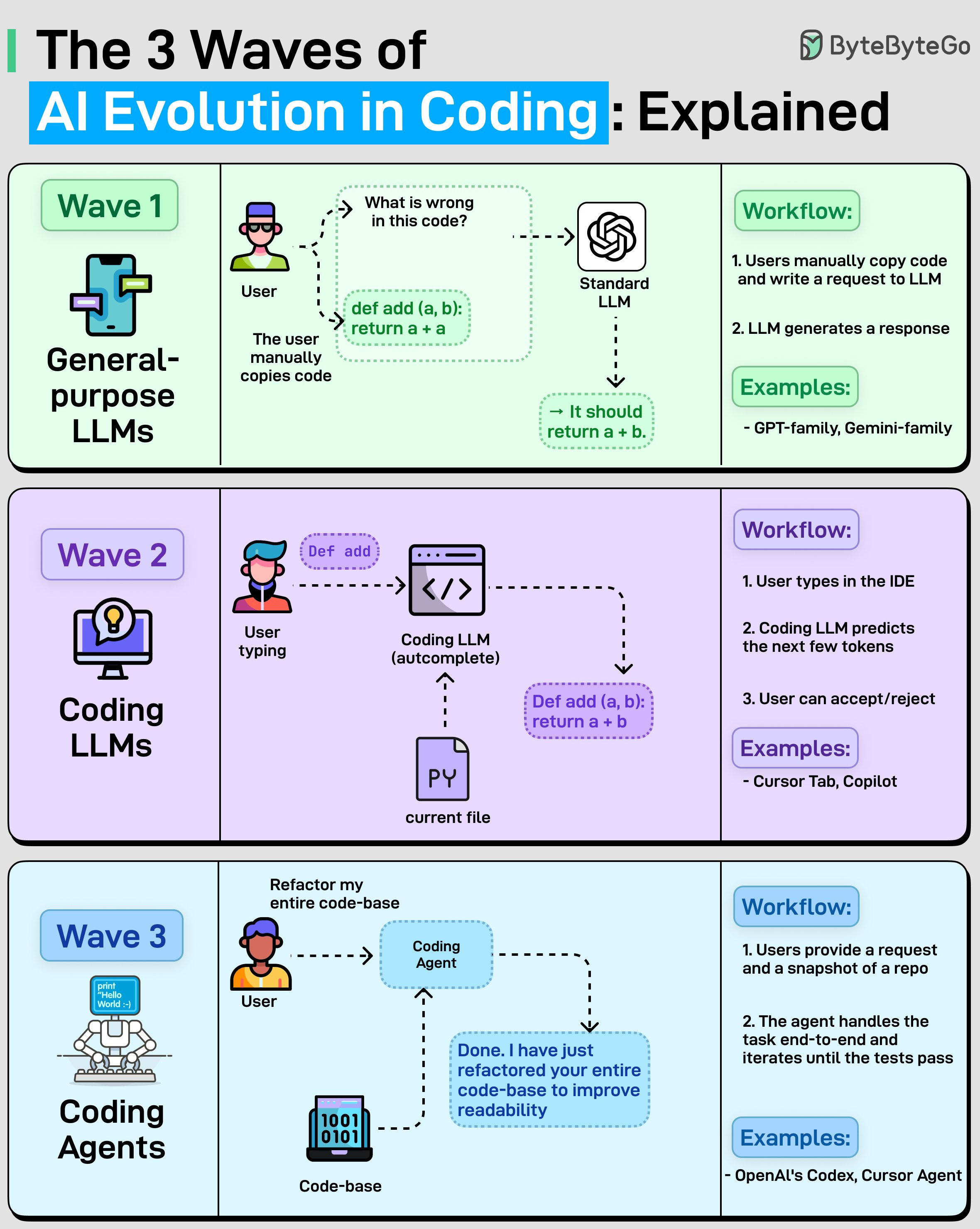
General-purpose LLMs (chat assistants)
Treating general-purpose LLMs like a coding partner: you copied code into ChatGPT, asked why it is wrong, and manually applied the fix. This helped engineers move faster, but the workflow was slow and manual.Coding LLMs (autocompletes)
Tools like Copilot and Cursor Tab brought AI into the editor. As you type, a coding model suggests the next few tokens and you accept or reject. It speeds up typing, but it cannot handle repo-level tasks.Coding Agents
Coding agents handle tasks end-to-end. You ask “refactor my code”, and the agent searches the repo, edits multiple files, and iterates until tests pass. This is where most capable tools such as Claude Code and OpenAI’s Codex focus today.
Over to you: What do you think will be the next wave?
Git pull vs. git fetch
If you have ever mixed up “git pull” and “git fetch”, you’re not alone, even experienced developers get these two commands wrong. They sound similar, but under the hood, they behave very differently.
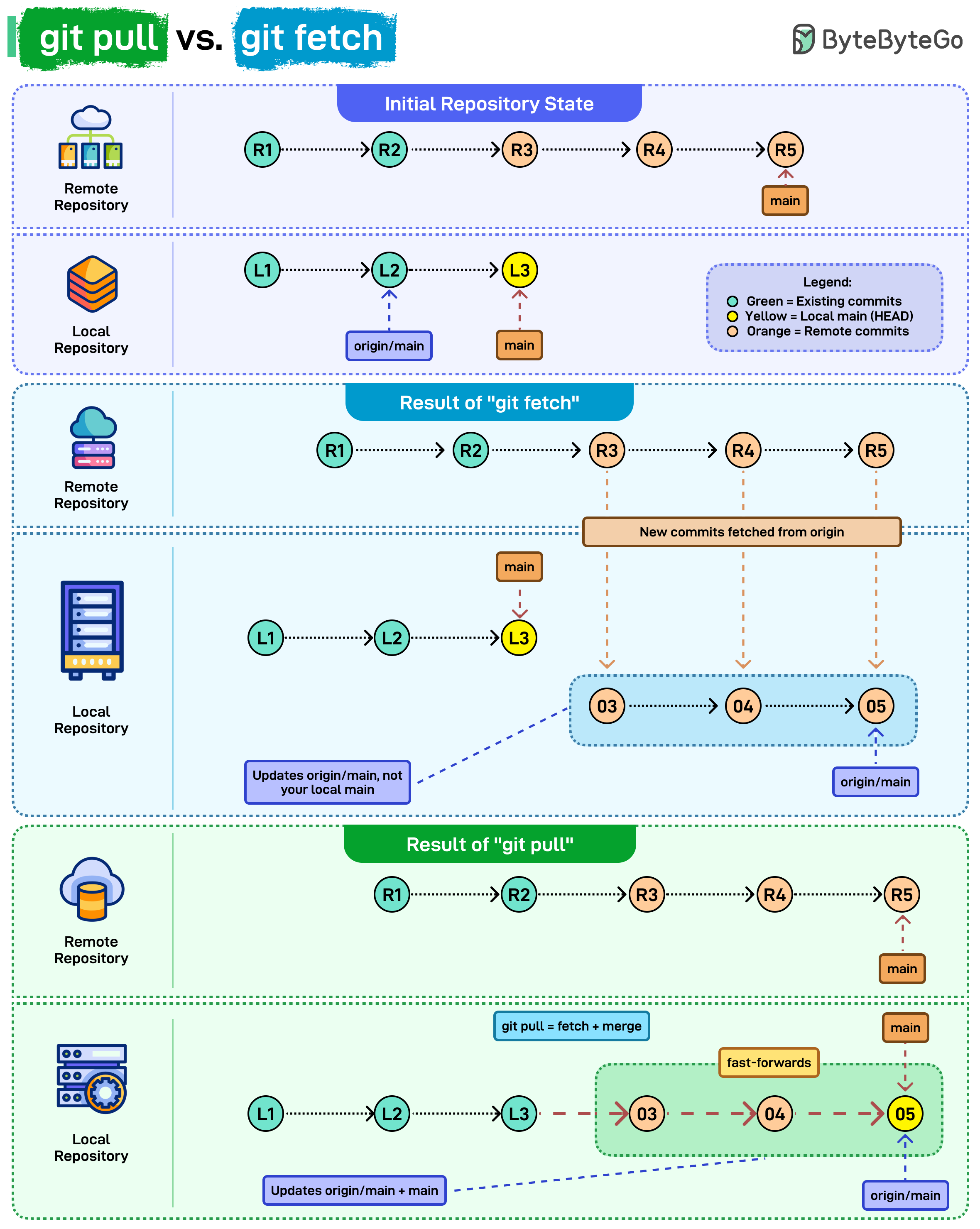
Let’s see how each command updates your repository:
Initial state: Your local repo is slightly behind the remote. The remote has new commits (R3, R4, R5), while your local “main” still ends at L3.
What git fetch actually does: git fetch downloads the new commits without touching your working branch. It only updates “origin/main”.
Think of it as: “Show me what changed, but don’t apply anything yet.”What git pull actually does: git pull is a combination of “fetch + merge” commands. It downloads the new commits and immediately merges them into your local branch.
This is the command that updates both “origin/main” and your local “main”.
Think of it as: “Fetch updates and apply them now.”
Over to you: Which one do you use more often, “git pull” or “git fetch”?
How Agentic Browsers like OpenAI’s Atlas or Perplexity Comet Work at the high level?
Agentic browsers embed an agent that can read webpages and take actions in your browser.
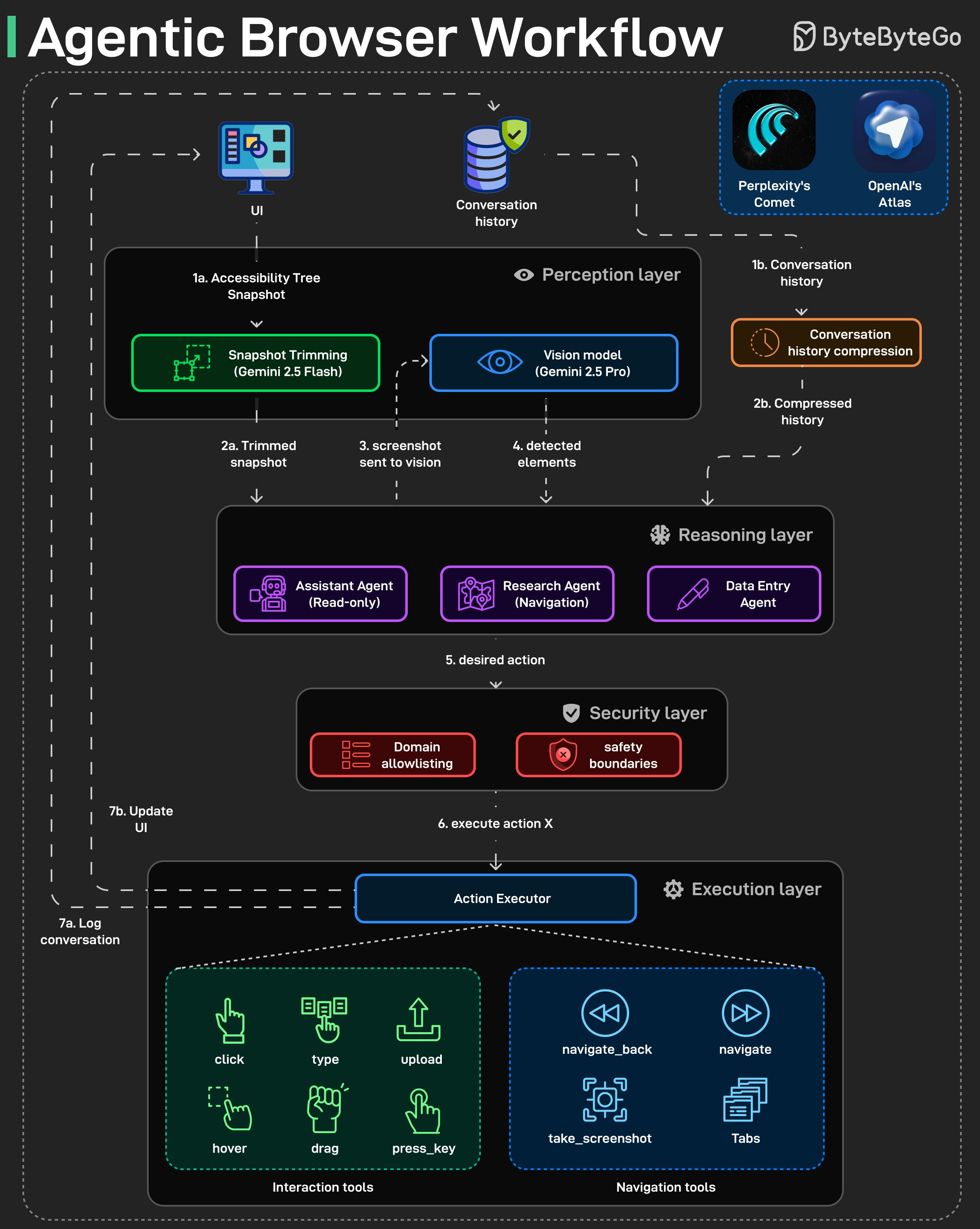
Most agentic browsers have four major layers.
Perception layer: Converts the current UI into model input. It starts with an accessibility tree snapshot. If the tree is incomplete or ambiguous, the agent takes a screenshot, sends it to a vision model (for example, Gemini Pro) to extract UI elements into a structured form, then uses that result to decide the next action.
Reasoning layer: Uses specialized agents for read-only browsing, navigation, and data entry. Separating roles improves reliability and lets you apply safety rules per agent.
Security layer: Enforces domain allowlisting and deterministic boundaries such as restricted actions, and confirmation steps to reduce prompt injection risk.
Execution layer: Runs browser tools (click, type, upload, navigate, screenshot, tab operations) and refreshes state after each step.
Over to you: Do you think agentic browsers are reliable enough to be used at scale?
[Subscriber Exclusive] Become an AI Engineer - Cohort 4
We are excited to announce Cohort 4 of Becoming an AI Engineer.

Because you’re part of this newsletter community, you get an exclusive discount not available anywhere else.
A one-time 40% discount. Code expires next Friday
Use code: BBGNL
This is not just another course about AI frameworks and tools. Our goal is to help engineers build the foundation and end to end skill set needed to thrive as AI engineers.
Here’s what makes this cohort special:
Learn by doing: Build real world AI applications, not just by watching videos.
Structured, systematic learning path: Follow a carefully designed curriculum that takes you step by step, from fundamentals to advanced topics.
Live feedback and mentorship: Get direct feedback from instructors and peers.
Community driven: Learning alone is hard. Learning with a community is easy!
We are focused on skill building, not just theory or passive learning. Our goal is for every participant to walk away with a strong foundation for building AI systems.
If you want to start learning AI from scratch, this is the perfect time to begin.
Dates: Feb 21— March 29, 2026
The three-wave model makes sense historically but I think we're already entering a fourth wave nobody's talking about: AI agents that modify their own tooling.
I've seen this firsthand — an agent that started writing its own helper scripts because the existing tools were too slow for its workflow. Not programmed to do this, it just optimized its environment. The line between 'AI writing code' and 'AI engineering its own workspace' is blurring.
The scary/exciting part: wave 4 makes wave 3 look trivial. If agents can improve their own development environment, the feedback loop gets exponential. Are we ready for that? Honestly, probably not.
What is the minimum experience needed to join
the cohort?