

What If Adding Auth to Your App Took One Command? (Sponsored)

npx workos launches an AI agent, powered by Claude, that reads your project, detects your framework, and writes a complete auth integration directly into your existing codebase. It’s not a template generator. It reads your code, understands your stack, and writes an integration that fits.
Then it typechecks and builds, feeding any errors back to itself to fix. Just run npx workos, from WorkOS.
This week’s system design refresher:
What Is Redis Really About? Why Is It So Popular? (Youtube video)
RabbitMQ vs Kafka vs Pulsar
What Are Agent Skills Really About? (Youtube video)
REST vs GraphQL
LAST CALL FOR ENROLLMENT: Become an AI Engineer - Cohort 4
What Is Redis Really About? Why Is It So Popular?
RabbitMQ vs Kafka vs Pulsar
RabbitMQ, Kafka, and Pulsar all move messages, but they solve very different problems under the hood.
This diagram looks simple, but it hides three very different mental models for building distributed systems.
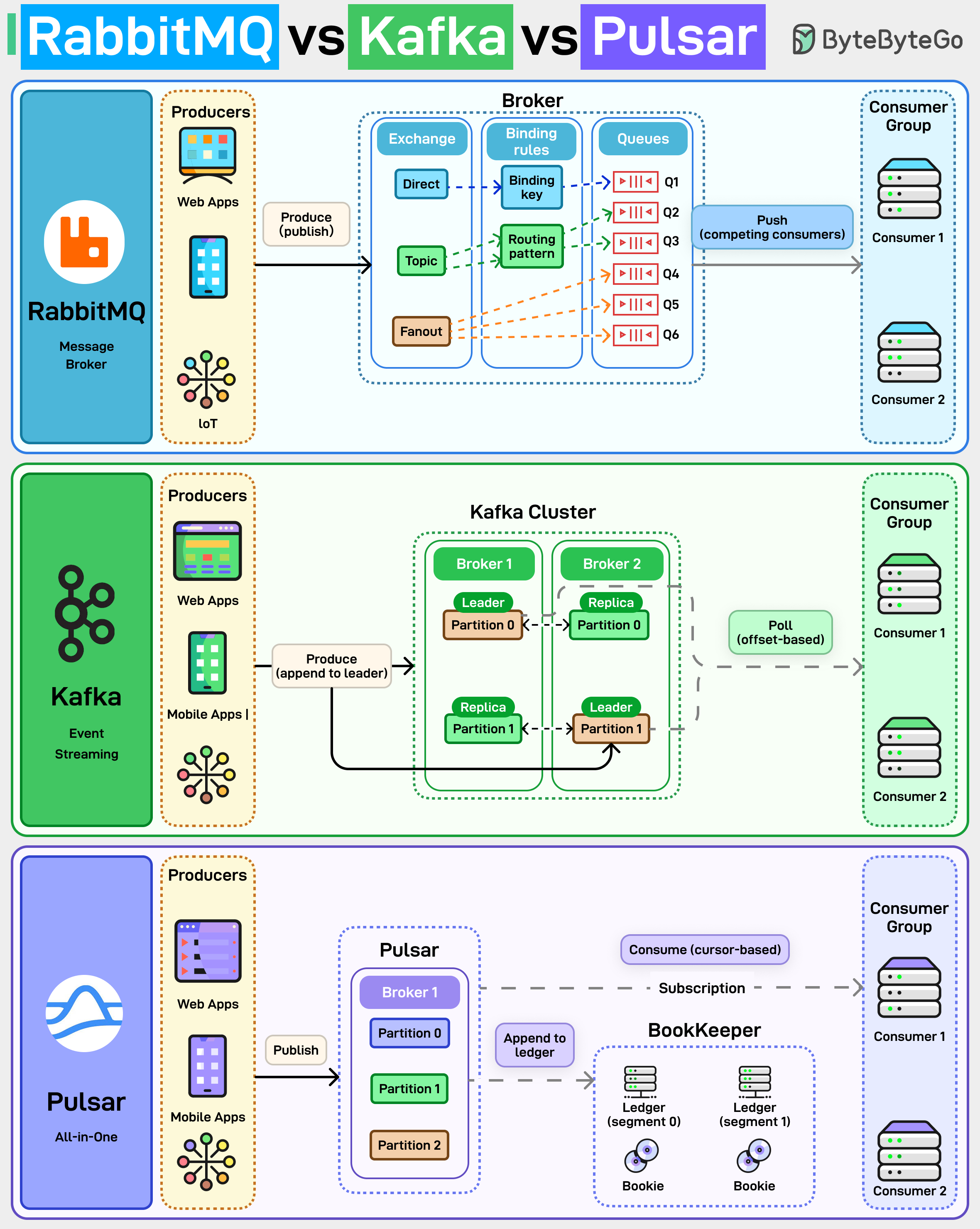
RabbitMQ is a classic message broker. Producers publish to exchanges, exchanges route messages to queues, and consumers compete to process them.
Messages are pushed, acknowledged, and then gone. It’s great for task distribution, request handling, and workflows where “do this once” really matters.
Kafka flips the model. It’s not a queue, it’s a distributed log. Producers append events to partitions. Data stays there based on retention, not consumption. Consumers pull data using offsets and can replay everything.
This is why Kafka works so well for event streaming, analytics, and pipelines where multiple teams need the same data at different times.
Pulsar tries to combine both worlds. Brokers handle serving traffic, while BookKeeper stores data in a durable ledger. Consumers track position with cursors instead of offsets.
This separation lets Pulsar scale storage and compute independently and support both streaming and queue-like patterns.
Choosing between them isn’t about “which is faster” or “which is popular.” It’s about how you want data to flow, how long it should live, and how many times it needs to be read.
New Relic Advance 2k26: Start your superhuman era (Sponsored)

Join us on February 24, 2026 (AMER) / February 25, 2026 (EMEA & APJ) for a free live webinar where we’ll unveil how Intelligent Observability can help you build smarter automations. During the event, you’ll see our new agentic platform in action—an essential tool if you’re working with AI Agents. We’ll also share key updates on our innovations in APM, Infrastructure, and the latest advancements in OpenTelemetry support. This is your opportunity to explore cutting-edge solutions designed to empower your work and streamline your operations.
What Are Agent Skills Really About?
REST vs GraphQL
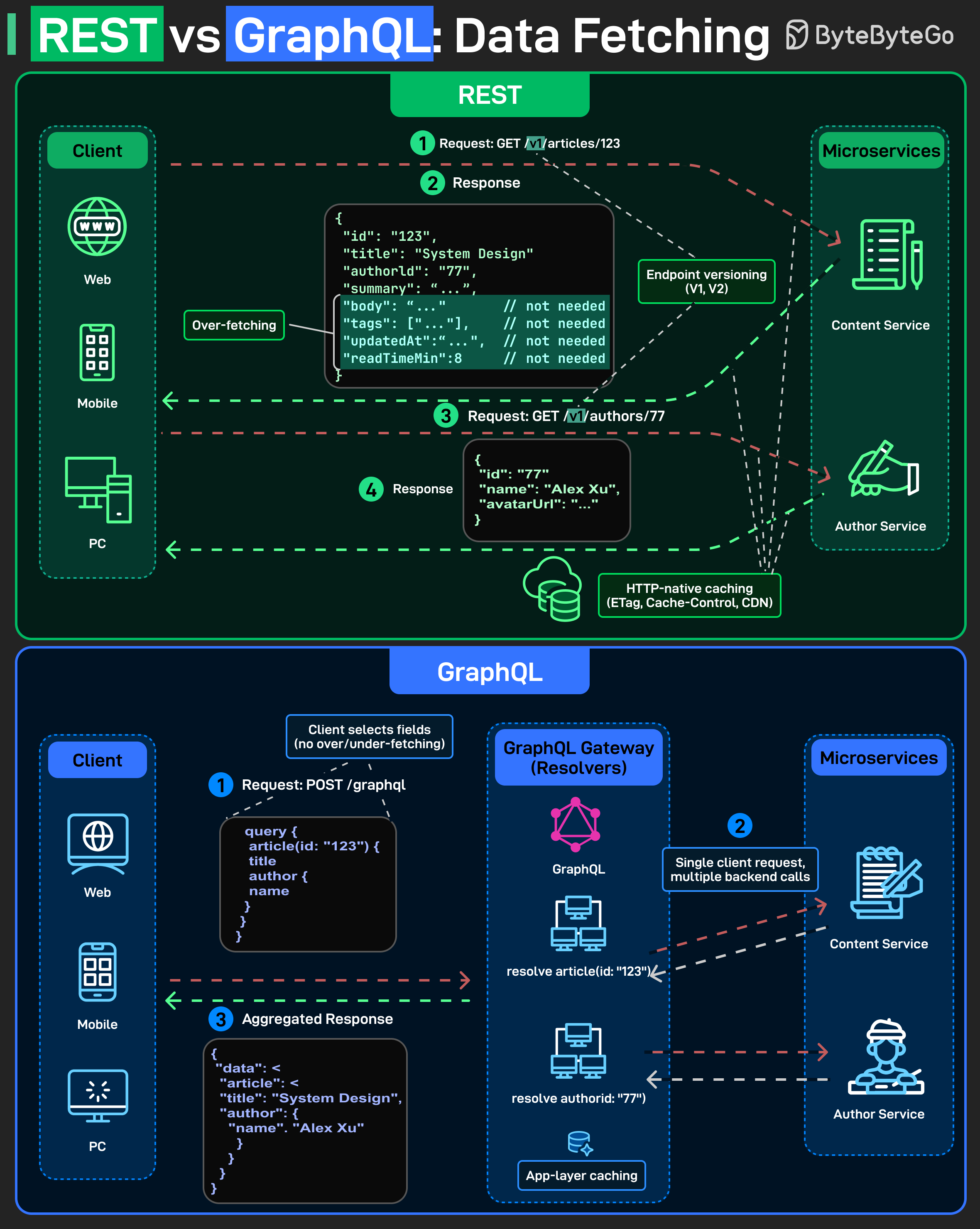
With REST, the server decides the response shape. You call “/v1/articles/123” and you get whatever that endpoint returns. If you need related data, you make another request. If the payload is larger than needed, you live with over-fetching.
HTTP gives you great primitives though: clear resource boundaries, URL-based versioning, and native caching via ETag, Cache-Control, and CDNs.
With GraphQL, the client decides the response shape. You send a single query describing exactly what fields you want. Behind the scenes, a GraphQL gateway fans out to multiple services, runs resolvers, and aggregates the response.
The complexity shifts from the client to the server. Caching still exists, but it usually lives at the application layer (persisted queries, response caching), not automatically at the HTTP layer.
Neither approach is “better” by default. REST optimizes for simplicity, cacheability, and clear ownership of resources. GraphQL optimizes for flexibility, client-driven data needs, and aggregation across services.
Over to you: What signals tell you REST is enough, and when GraphQL becomes worth it?
LAST CALL FOR ENROLLMENT: Become an AI Engineer - Cohort 4
Enrollment for our upcoming Become an AI Engineer - Cohort 4 is closing soon, and classes officially begin on February 21.
Get 40% on your registration cost with code: BBGNL

This is not just another course about AI frameworks and tools. Our goal is to help engineers build the foundation and end to end skill set needed to thrive as AI engineers.
Here’s what makes this cohort special:
Learn by doing: Build real world AI applications, not just by watching videos.
Structured, systematic learning path: Follow a carefully designed curriculum that takes you step by step, from fundamentals to advanced topics.
Live feedback and mentorship: Get direct feedback from instructors and peers.
Community driven: Learning alone is hard. Learning with a community is easy!
We are focused on skill building, not just theory or passive learning. Our goal is for every participant to walk away with a strong foundation for building AI systems.
If you want to start learning AI from scratch, this is the perfect time to begin.
What about NATS/Jetstream?
Good breakdown of the mental models. From production experience, I'd add a word of caution on RabbitMQ specifically: it tends to hold up beautifully in early stages, which builds a false sense of confidence. The breakdowns usually come later queue depth spikes under backpressure, memory alarms triggering flow control at the worst possible moment, or consumers falling behind in ways that are hard to recover from gracefully.
The diagram captures the architectural differences well, but the real pain isn't in understanding the models it's in the moment your team realizes the tool they chose six months ago wasn't built for the load they're seeing today. RabbitMQ's "messages are gone after ack" model is a feature, until it isn't and you need to replay.
The choice between these three is rarely about features on paper. It's about which failure modes your team is prepared to handle at 2am.