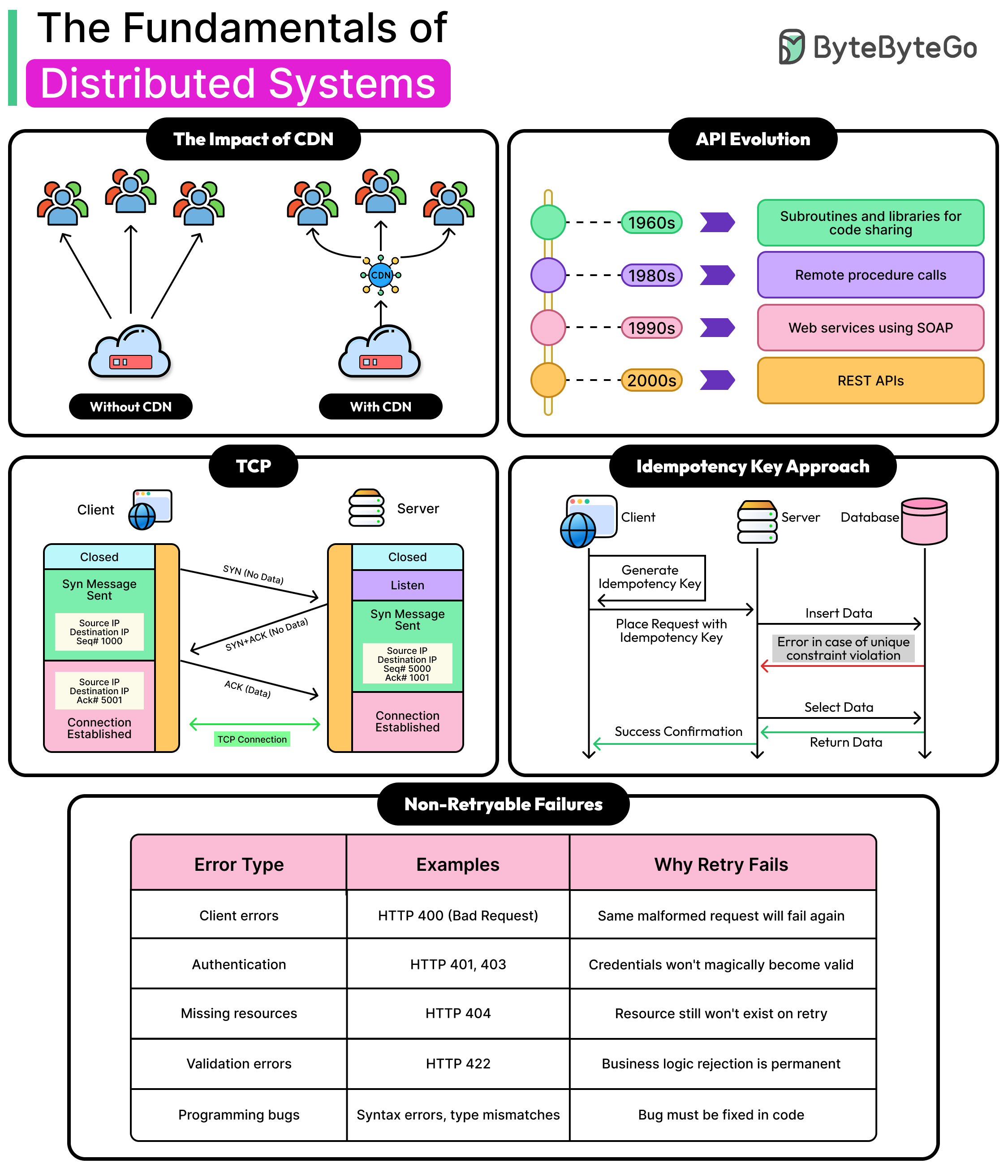
Every Google search, Netflix stream, and bank transfer relies on distributed systems where multiple computers work together to accomplish tasks impossible for a single machine. Understanding how these systems handle communication, failures, and coordination is becoming essential for modern software developers.
The fundamental challenge that makes distributed systems different is partial failure. In single-computer programs, everything typically crashes together. In distributed systems, some components can fail while others continue operating. For example, a database might crash while web servers keep running, or network connections might fail while both services remain healthy.
This creates ambiguity. When we send a request and receive no response, we cannot determine what happened.
Did the request never arrive?
Did the server process it, but crash before responding?
Did the response get lost?
Every concept in distributed systems addresses some aspect of this challenge.
In this article, we will look at five foundational topics around distributed systems: how computers communicate across networks, the protocols enabling reliable communication, how remote procedure calls abstract complexity, strategies for handling failures, and why time synchronization presents unique challenges.